
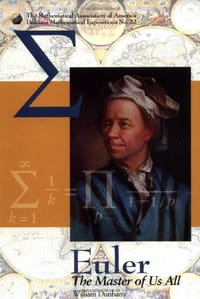
书籍介绍
Leonhard Euler (1707-1783) was a man of faith: by evening he led the family Bible study, and by day he manipulated infinite series and assigned limits also by faith, if not by sight. Lacking clear definitions and useful theorems for the concepts of function, limit, and convergence, unencumbered by logical rigor, and despite progressive blindness, Euler did not hesitate to invent extraordinarily creative ways to manipulate equations and discover new truths in all fields of mathematics. Later generations have marveled at Euler’s insight and creativity, even as they have established rigorous verifications for his results.
Euler’s greatest early fame came in 1735 when he solved Jakob Bernoulli’s “Basel problem” by establishing the remarkable result that the sum of the reciprocals of the squares of the positive integers converges to one-sixth the square of pi. His collected works, written in Latin, French, and German, comprise more than 70 volumes. Thus, despite Laplace’s famous advice to “Read Euler, read Euler,” many modern inquirers will choose instead to read Dunham’s superb introduction to Euler’s accomplishments in eight selected areas of mathematics (number theory, logarithms, infinite series, analytic number theory, complex variables, algebra, geometry, and combinatorics). Dunham writes for a mathematically literate reader who has mastered calculus, but not necessarily much beyond that. For each topic, Dunham sets the mathematical context, provides clear, concise, and sometimes beautiful explanations of Euler’s accomplishments, and mentions subsequent developments by other mathematicians.
Dunham includes a short biography, and repeatedly envisions how Euler must have enjoyed his unexpected twists of thought. The reader also should smile at Euler’s inventiveness, such as when he used the divergence of the harmonic series to show that there are infinitely many primes.
用户评论
欧拉的生平,激起了我读欧拉全集的冲动
建生祠,搞个人崇拜。欧拉我爱你
It is terrifying to see what he has done.
Read Euler, Read Euler, he is the master of us all!
前人如此,后人何堪
欧拉的作品,以及作者Dunham的努力,成就了这本书!作者文笔一流。读起来也很轻松(这要归功于作者)。
“读读欧拉,读读欧拉,他是我们所有人的老师。”