
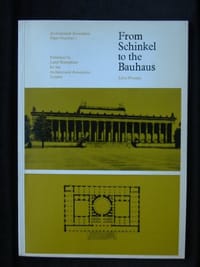
From Schinkel to the Bauhaus
出版时间
1972-05-01
ISBN
9780853312451
评分
★★★★★
精彩摘录
- "Posener, Julies, “Schinkel’s English Diary” in “From Schinkel to the Bauhaus: Five Lcetures on the Growth of Modern German Architecture”, “AA Paper No.5”, London: The Architectural Association,c.1972, pp.11-15。 《申克尔的英国日记》 申克尔是于1826年来到不列颠的。他是跟好友、工程师贝伊特(Beuth)一起旅行的。他们从巴黎过来。此行是受普鲁士皇室委托出来考察,因此是绝对官方之行。贝伊"
- "Julius Posener’s lecture given to the AA School and the AA on various occasions during 1967 and 1968 were memorable events. That they are now available to a much wider audience is welcome for two reasons: they present an insight into the development of modern architecture in Germany from Schinkel to"
- "When Professor Posener was invited to present his lectures we had hoped that he would clarify the relationship between various key figures in German architecture and the aims of certain designers. This he did admirably. In the lectures he examined the importance of Karl Friedrich Schinkel in the nin"
- "This edited volume opens with a discussion of the diary of Karl Friedrich Schinkel whose name is known, but whose work and ideas are virtually unknown, in Britain. This is a lamentable state of affairs for on who has been described as ‘the greatest German architect’ of the early part of the nineteen"
- "Better known in English circles is the Prussian diplomat, architect and connoisseur Herman Muthesius… In some ways Muthesius acted like the power behind the throne of German Imperialism, in his role as the arch- rationalizer of German product design… No wander he was admired by his indefatigable Eng"
- "But standardization must not be looked at in isolation. Muthesius, Behrens and Gropius were committed to the idea of ‘type’… Their importance in the development of the Modern Movement is indisputable and although, as Posener says, Muthesius’s influence as an architect is negligible, his attitude to "
- "It does not seem out of place to include here Professor Posener’s translation of the 1914 Directives: 1 Architecture and the whole province of Werkbund activity with it, tend toward developing types. It is this tendency which may restore to architecture the important place it held in periods of cult"
- "2 Developing types will be the result of a wholesome concentration. This will help to establish again accepted criteria of taste."
用户评论
Posener的AA五讲,包括:辛克尔的英国日记;穆特休斯(Muthesius)在英国;波尔奇齐(Poelzig)和表现主义建筑; 贺林、夏隆、密斯和柯布; 包豪斯的前历史的某些侧面;出乎预料地棒!
申克尔对技术与新生活的兴趣;Durand对Boullee形式的背叛,分裂出永恒建筑与可替换风格;申克尔的建筑强调教养(Bildung)。Muthesius将英国民居的功能主义拿过来,催生德意志制造联盟,推动工艺、制造、类型建筑。Poelzig等表现主义者;Brehens、Mendelson在形式下对建造的意识。Haring的功能主义(building而非architecture)、密斯的语法主义之外的第三条路柯布西耶:外部形体的雕塑性与内部空间的自由的融合。制造联盟与表现主义的理念,风格派与柯布西耶的风格影响,造就了包豪斯作为第一个反传统(非折衷)的新风格。
Posener sorts out admirably the relations among various architectural trends and figures (mostly in Germany) from the late 19th century to the early 20th century.
an alternative way to interpret modernism, especially and interestingly to see the transition from Muthesius to Hugo Haring. Posener gave a series lectures on prominent German architects, including Schinkel, Muthesius, Haring, Scharoun, and Mies, etc.
Posener从Schinkel 到英国考查的事件开始,梳理了前包豪斯时代的历史背景,虽然Schinkel 的篇幅很小,但从muthesius,到Hugo haring,然后进入le corbusier 和以及国际主义,脱离不开辛克尔对古典建筑体系的现代主义创新,很有趣
@2012-05-04 19:01:55
精辟简练
求书
收藏