
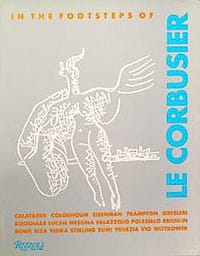
书籍介绍
西扎讲的是:重访萨沃依;
埃森曼的话题是:现代主义的一面:多米诺住宅与自我援引的符号。
库哈斯讲的是:光明之城。。。。。
合集;
有Wittkower, Eisenman, Reichlin, Siza, Stirling, Colquhoun....等人,从多个角度谈柯布
精彩摘录
- "At a recent meeting at the Royal Institute of British Architects in London to which I was a party (June 18, 1957), the motion was before the house “that Systems of Proportion make good design easier and bad design more difficult.” The motion was defeated. But in the debate Le Corbusier’s Modulor was"
- "In 1948 Le Corbusier surprised the architectural world with his Modulor. The book was quickly sold out. Le Corbusier himself, whom I may (perhaps not to charitably) describe as a cross between a prophet and a salesman of rare ability, brought the story up to date in 1954, with the publication of his"
- "The Beaux Arts tradition, according to which proportion is something vague, indefinable, irrational – a “something” that must be left to the individual architect’s sensibility – that tradition is as dead as a doornail. If it is not, it should be. Be that as it may, I find it difficult or even imposs"
- "So far as I can see, the belief in an order, divine and human, derived from numbers and relations of numbers was always tied to higher civilizations. All systems of proportion are implicitly intellectual, for they are based on mathematical logic. Without a grasp of geometry and the theory of numbers"
- "It must be regarded as one of the most extraordinary events in the early history of mankind when a bridge was created between abstract mathematical thought and the phenomenal world that surrounds us; when geometry and numbers were found to govern the skies as well as all creation on earth. The Bible"
- "The intellectualism of this daring hypothesis must not lead us astray, for in reality we are here faced with a biologically conditioned sublimation. The quest for symmetry, balance, and proportional relationship is deeply embedded in human nature. Modern antagonists always claim that systems of prop"
- "Man’s predisposition for ordering complex sensory stimuli can easily be tested. For instance, we interpret automatically irregular configurations as regular figures (see Arnheim, Art and Visual Perception, fig. 44). Such incontestable observations permit us to conclude that we seek ordered patterns;"
- "All systems of proportion in Western art and architecture, the only civilization we are concerned with, are ultimately derived from Greek thought. Pythagoras, living in the sixth century B.C., is credited with the discovery that the Greek Musical scale depends on the division of a string of the lyre"
作者简介
合集;
有Wittkower, Eisenman, Reichlin, Siza, Stirling, Colquhoun....等人,从多个角度谈柯布
用户评论
《踏着柯布的足迹走》。很精彩的合集。稍后我会贴上几章译稿,但是最好去对着原文读。




收藏