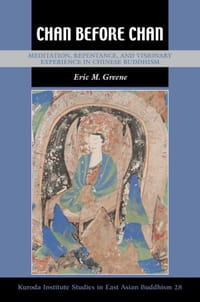
What is Buddhist meditation? What is going on—and what should be going on—behind the closed or lowered eyelids of the Buddha or Buddhist adept seated in meditation? And in what ways and to what ends have the answers to these questions mattered for Buddhists themselves? Focusing on early medieval China, this book takes up these questions through a cultural history of the earliest traditions of Buddhist meditation (chan), before the rise of the Chan (Zen) School in the eighth century. In sharp contrast to what would become typical in the later Chan School, early Chinese Buddhists approached the ancient Buddhist practice of meditation primarily as a way of gaining access to a world of enigmatic but potentially meaningful visionary experiences. In Chan Before Chan, Eric Greene brings this approach to meditation to life with a focus on how medieval Chinese Buddhists interpreted their own and others’ visionary experiences and the nature of the authority they ascribed to them.
Drawing from hagiography, ritual manuals, material culture, and the many hitherto rarely studied meditation manuals translated from Indic sources into Chinese or composed in China in the 400s, Greene argues that during this era meditation and the mastery of meditation came for the first time to occupy a real place in the Chinese Buddhist social world. Heirs to wider traditions that had been shared across India and Central Asia, early medieval Chinese Buddhists conceived of “chan” as something that would produce a special state of visionary sensitivity. The concrete visionary experiences that resulted from meditation were understood as things that could then be interpreted, by a qualified master, as indicative of the mediator’s purity or impurity. Buddhist meditation, though an elite discipline that only a small number of Chinese Buddhists themselves undertook, was thus in practice and in theory constitutively integrated into the cultic worlds of divination and “repentance” (chanhui) that were so important within the medieval Chinese religious world as a whole.
Eric M. Greene is assistant professor of religious studies at Yale University.