
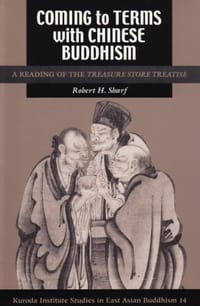
Coming to Terms with Chinese Buddhism
出版时间
2005-11-30
ISBN
9780824830281
评分
★★★★★
书籍介绍
这本书最锋利之处,在于它把'中国佛教如何被外来佛教塑造'这个被奉为常识的叙事连根拔起。作者指出:中古时期的中国人其实很少直接接触印度僧团与梵文原典,所谓'佛教中国化'更多是中国人自己内部的对话产物,而非对印度范本的扭曲摹本。这一判断之所以'读得很爽',正因为它戳破了学界长期用梵文术语给中文概念贴标签的惰性——我们总急着给'感'找技术性的梵语'等价词',却忽略了中国人问的从来是中国人自己的问题。全书以《宝藏论》为解剖样本,展示佛道思想如何相互含摄,并以'感应'宇宙观给出一个极具说服力的本土化个案。它适合那些不愿接受现成结论、想追问'中国佛教究竟是谁的佛教'的读者。
作者简介
Professor Robert Sharf received his B.A. (Religious Studies) and M.A. (Chinese Studies) from the University of Toronto and his Ph.D. (Buddhist Studies) from the University of Michigan. He taught at McMaster University (1989-95) and the University of Michigan (1995-2003) before joining the Berkeley faculty. He works primarily in the area of medieval Chinese Buddhism (especially Chan), but he also dabbles in Japanese Buddhism, Buddhist art, ritual studies, and methodological issues in the study of religion. He is author of Coming to Terms with Chinese Buddhism: A Reading of the Treasure Store Treatise (2002), co-editor of Living Images: Japanese Buddhist Icons in Context (2001), and is currently working on a book tentatively titled How to Read a Zen Koan. In addition to his appointment in EALC he serves as Director of the Group in Buddhist Studies, Director of Religious Studies, and Chair of the Center for Buddhist Studies.
AI导读
核心看点
- 本书核心挑战了‘中国佛教是印度佛教汉化产物’的传统范式,作者通过严谨考证指出,中古时期中国人接触南亚僧侣与梵文原典的机会极为有限,所谓的中印文化碰撞在历史上并未如传统叙事那般深入发生。
- 作者强调中国佛教应被视为中华本土文化的产物,而非印度佛教规范的扭曲反映。书中深入剖析了《宝藏论》等伪经文本,揭示其思想根源实为道家、儒家及本土宇宙观,而非印度佛学,以此论证中国佛教的独立性。
- 书中对‘感应’宇宙观及密教实践进行了去神秘化解读,指出唐代密宗并非独立宗派,而是被还原为具体的技术与仪式。作者批判现代学者用西方认识论与本体论二分法强行切割中国佛教概念,主张回归历史语境理解本土宗教实践。
读者共识
- 读者普遍认可本书导论部分具有极高的学术价值,对‘佛教中国化’范式的解构令人耳目一新,批判力度强且逻辑严密。许多读者表示阅读序言及第一章后感到‘很爽’,认为其深刻揭示了既往研究的盲点,是反思佛教史研究方法的典范之作。
- 尽管赞赏其批判精神,但多数读者指出作者结论过于极端,完全否定中印文化交流的实质内容,陷入另一种‘本土中心主义’的窠臼。读者认为这种‘非此即彼’的二分法缺乏历史复杂性,未能合理解释印度佛教思想对中国文化的真实影响,存在以偏概全之嫌。
- 读者认为本书在文献考据与文本分析上展现了极高的专业水准,尤其是对《宝藏论》与道家思想关联的揭示极具启发性。但同时也警告,书中部分观点过于挑衅,可能得罪同行,且其激进立场可能导致对历史事实的另一种歪曲,需谨慎对待其最终结论。
精彩摘录
- "Accordingly, in order to understand the answers they found, we must first deduce the questions they were asking, questions whose historical, linguistic, and conceptual genealogy was largely Chinese. This elementary and oft-repeated Gadamerian insight tends to be ignored in the scholarly act of gloss"
- "Robert van Gulik found that in China, as in Japan, the ability to read and write the Indian Siddham script was regularly mistaken for mastery of Sanskrit proper and that many of the East Asian clerics renowned for their proficiency in Sanskrit had little if any command over the grammar, or even the "
- "Unlike Wang Pi’s 王弼 (226–249) approach to the Tao-te ching, which tended to exalt nonbeing over being, or the commentary to the Chuang-tzu by Hsiang Hsiu 向秀 (ca. 221–ca. 300) and Kuo Hsiang 郭象 (d. 312), which exalted being over nonbeing, the rhetorical strategy of the Twofold Mystery authors, borrow"
- "Su-tsung 唐肃宗 (r. 756–762) followed the policies of his predecessor in favoring Taoism"
- "There are striking, if potentially misleading, parallels between the notion of a buddha as inwardly and outwardly quiescent and the silence of the sage-king Shun, who does nothing yet leaves nothing undone. I have already touched on the apparent congruity between the Chinese cosmology of organic hol"
- "The interpretation of the term “kan” 感 is rendered problematic by the implicit Cartesian metaphysical assumptions that inform the modern distinction between epistemology and ontology. The earliest Chinese etymological dictionary, the Shuo-wen chieh-tzu 说文解字, defines kan as “to move a person’s mind” "
- "Occurrences of the term “kan fo” in medieval Buddhist materials resist attempts to distinguish epistemological from ontological readings. The desire for a precise analysis of the metaphysical status of divinity, not to mention the desire for a consistent English rendering, is frustrated by what at f"
目录
ACKNOWLEDGMENTS
ABBREVIATIONS
CONVENTIONS OF USAGE
Introduction: Prolegomenon to the Study of Medieval Chinese Buddhist Literature
Part 1: The Historical and Cosmological Background
显示全部
用户评论
序言對「Sinification」範式的解構,痛砭頑疾,讀得很爽。但話鋒一轉,結論「encounter」幾近沒有發生,又落入兩分的窠臼。
绪论写得非常棒!对当前中古佛教研究领域的问题进行了深刻的反思,且涉及面广,对固有成说的批判也是一针见血。
此书写得非常厉害。导论质疑中国佛教的被动接受史叙述,而强调将其本土化。第一部分前半部分析7-8世纪伪佛书《宝藏论》与道家、禅宗思想的相互含摄;后半部以“感应”宇宙观为例,给出了一个十分有说服力的“本土化”个案分析。第二部分为《宝藏论》英文翻译及注释。附论则解构作为宗派的唐代密宗,而从宗教实践的角度将其还原成技术与仪式。是当代学者反思佛教“中国化”范式的典范之作。
论文用过,补标。
很久之前读过intro,如今再读,还是觉得精彩炫目。Sharf的批判很深刻:在进入汉地的那刻起,sinification便已实现,此后的发展运作基本均围绕汉语展开;syncretism的预设是存在两支在相遇前各自发展的传统,但这只是本质主义的想象;建构的话语与实际的历史有诸多差别,建构是排异的,因而时刻需声明自身权威及树立异端他者,宗派也在这一过程中整齐分明。但在真实情境中,orthodox只是一种可供互相挪用的修辞策略。于是作者的落脚点便置于汉地语言及文化传统对佛教的吸收与展现,传统的感应观与外来的佛教相“感应”,而这一运作得以达成的前提便是:二者间本即存在可供接受的共通之处,或者说,异质之处便难以引起感应。然而,解构的问题在于——难以回应同相与殊相的问题,即使再锋利的拆解也无法回避拼合。
读完以第一章,爽
批判性很强的一本书
University of Hawaii Press的其他书籍查看全部
 Minority Stages
 Theater of the Dead
 The Making of the First Korean President
 Literary Remains
 Remote Homeland, Recovered Borderland
 Confucian Role Ethics
求书
收藏