
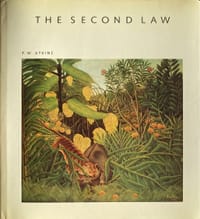
The Second Law
出版时间
1984-02-01
ISBN
9780716750048
评分
★★★★★
书籍介绍
The novelist and physicist C. P. Snow once remarked that not knowing the Second Law of thermodynamics was analogous to never having read a work of Shakespeare's. This profusproductely illustrated volume breaks down the mathematical barriers that have prevented many from understanding this fundamental principle of energy transformation and describes the origin, atomic basis, and wide-ranging applications of this central, unifying description of all natural change.
Simply stated, the Second Law recognizes the intrinsic asymmetry in nature. Aspects of this asymmetry can be found all around us: hot objects cool, but cool objects do not spontaneously become hot; a bouncing ball comes to rest, but a stationary ball does not spontaneously begin to bounce. Oxford professor P. W. Atkins begins his examination of these seemingly random but vitally important phenomena with early observations of the steam engine and traces the deepening understanding that emerged when the atomic basis of the Law was established. He analyzes the Law from a modern viewpoint, enabling us to see how a single, simple idea encompasses all elements of natural change.
Atkins explores this idea from its first recognition through its application in engines, refrigerators, and heat pumps to its role as the driving force of chemical reactions and, finally, to the emergence of the exquisitely ordered structures characteristic of life itself.
Using striking computer graphics to develop a unified picture of nature, the author shows us how structures are built apparently out of chaos until we grasp the underlying, awesome simplicity of complexity. An appendix details how to program the generation of printouts of the concepts discussed.
用户评论
读这本书是因为James Lovelock在他自传里说想了解熵的话最好读这本书。JL自己则是用熵的原理在火星探测器之前很久就证明了火星上不存在生命。但这本书实在不好找,最后从美国搞了本二手书回来,因为疫情也是辗转隔了很久到去年底才到手。这本书真的写得很棒,非常浅显而生动地将引擎、化学反应、分子结构、乃至生命过程如何在混乱(无序)中产生讲了出来,并且上天入地,横跨大爆炸后的极高温度到接近绝对零度的冰冷寂灭。这本书写于1984年,现在读来仍然很有趣味,也让我弄明白了一直没弄明白的“熵”的概念。
你可能会关注的书籍
 The Fallacy of the Second Law of Thermodynamics and the Feasibility of Transmuting Terrestrial Heat Into Available Energy; An Addendum to Essay on \Me"
 Entropy and the Second Law
求书
收藏