
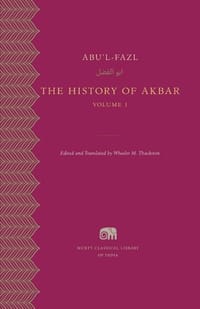
The History of Akbar, Volume 1
出版时间
2015-01-06
ISBN
9780674427754
评分
★★★★★
书籍介绍
Akbarnāma, or The History of Akbar, by Abu’l-Fazl (d. 1602), is one of the most important works of Indo-Persian history and a touchstone of prose artistry. Marking a high point in a long, rich tradition of Persian historical writing, it served as a model for historians throughout the Persianate world. The work is at once a biography of the Mughal emperor Akbar (r. 1556–1605) that includes descriptions of his political and martial feats and cultural achievements, and a chronicle of sixteenth-century India. The first volume details the birth of Akbar, his illustrious genealogy, and in particular the lives and exploits of his grandfather, Babur, and his father, Humayun, who laid the foundations of the Mughal Empire. The Persian text, presented in the Naskh script, is based on a careful reassessment of the primary sources.
The Murty Classical Library of India makes available original texts and modern English translations of the masterpieces of literature and thought from across the whole spectrum of Indic languages over the past two millennia in the most authoritative and accessible formats on offer anywhere.
The [Murty Classical Library of India] aims to make Indian literature accessible to a wide audience, so that ever larger circles of individuals can discover the history, philosophy, and drama of India. As the volume of this library that I read, The History of Akbar (Volume 1) proved, the Murty Library has succeeded in its goal of sharing valuable knowledge and providing interesting insights on India…This particular volume provides valuable insight into both the history and historiography of the Mughals. (Akhilesh Pillalamarri The Diplomat 2015-01-30)
At a time when Hindutva historians are eager to distort the history of Muslim invasions in order to deepen religious cleavages and consolidate vote banks, [Abu’l-Fazl's] elaboration of Akbar’s legacy as a tolerant Muslim ruler of a non-Muslim majority is an important reminder of how Indian society has evolved. (Pragya Tiwari India at LSE blog)
We can only welcome an undertaking like the Murty Classical Library of India, which intends to inject fresh blood directly into the circulatory system of the English language. Any intelligent reader cannot fail to be favorably impressed in the presence of the variegated offerings of the series’ first titles…The Murty Classical Library offers a surprising array of texts that are in any case capable of broadening the all-too-restricted horizons of the average Western reader. (Roberto Calasso New York Review of Books 2015-09-24)
Harvard University Press的其他书籍查看全部


收藏