
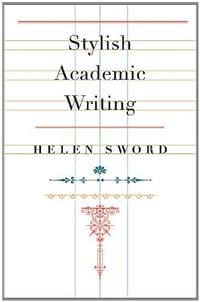
Stylish Academic Writing
出版时间
2012-04-02
ISBN
9780674064485
评分
★★★★★
书籍介绍
这不像一本教你遵守规则的写作手册,更像一次对学术写作陈规的“叛乱”。作者海伦·索德没有急着告诉你“该怎么做”,而是先翻出一千多篇各学科的期刊论文,让你看清一个尴尬事实:学者们嘴上推崇清晰生动,笔下却纷纷滑向冗长、被动、术语堆砌。这种“知行不一”的测量,是全书最锋利也最有争议之处——它把“写得烂”从个人能力问题,变成了可被统计的群体习惯。书里那些“尝试一下”的小练习切实可用,但正因选材偏文科、且以牺牲部分严谨性换取可读性,它也招致“理科期刊样本不足”的批评。适合那些被八重引号、长括号和无人称句折磨得写不下去,又舍不得放弃思考深度的读者。
作者简介
Helen Sword is Professor and Director of the Centre for Learning and Research in Higher Education at the University of Auckland.
AI导读
核心看点
- 基于千篇论文实证,破除学术写作必须晦涩的迷思
- 提出具体、选择、勇气三大原则,重塑写作风格
- 每章附实用练习,指导如何写出清晰有力的文本
读者共识
- 文风生动幽默,是沉闷学术写作中的一缕清风
- 部分建议可能牺牲严谨性,需读者自行权衡取舍
- 适合进阶者锦上添花,初学者可能面临实践困难
精彩摘录
- "Lengthy parenthetical citations violate, or at least risk violating, two key principles of stylish writing. First, they slow the text’s momentum: how can you possibly tell a compelling research story if you have to stop and cough every few seconds?Second, much in the same way that discursive footnot"
- "Concrete language is arguably the single most valuable tool in the stylish writer's toolbox. When readers encounter a sentence composed largely of concrete nouns, they can immediately visualize its objects, actions, and relationships, ... but takes care to balance them with appeals to sensory experi"
- "● Clarity, Coherence, Concision: Strive to produce sentences that are clear, coherent, and concise. ● Short or Mixed- Length Sentences: Keep sentences short and simple, or vary your rhythm by alternating longer sentences with shorter ones. ● Plain En glish: Avoid ornate, pompous, Latinate, or waffly"
- "An effective fi rst paragraph need not be fl ashy, gimmicky, or even provocative. It must, however, make the reader want to keep reading."
- "• Use this only when accompanied by a modifying noun (“This argument shows” rather than merely “This shows”). Writers often slip this into their sentences to avoid stating their ideas clearly (“Some have seen this as conclusive evidence that . . .”). • Use it only when its referent— that is, the nou"
- "The Abstract Noun of Abstract Noun in Plural Collective Noun: An Adjective and Adjective Abstract Noun."
- "• Move 1: Establish that your par tic u lar area of research has some significance. • Move 2: Selectively summarize the relevant previous research. • Move 3: Show that the reported research is not complete. • Move 4: Turn the gap into the research space for the present article."
- "I would like to add three further Cs: concreteness, choice, and courage. Concreteness is a verbal technique; choice, an intellectual right; courage, a frame of mind. Together, these principles offer a flexible framework on which writers from different disciplines can drape a rich variety of words an"
用户评论
和本书中所推崇的写法一样,整本书非常well-crafted并且花了很大力气play around with language,对于本硕阶段的中国学生写作没啥太大帮助,因为其中提到的很多毛病是词汇量本不丰富的中国学生所不会有,或者因为语言能力而力所不能及的,不是写作风格的问题而是语言能力的问题。但书中不乏有启发之处,即便很花里胡哨但仍旧让我学到不少。
读完之后最大感悟:少写抽象话,尽量让语言变得生动有趣。
很实用的一本书,特别是每章最末都附有建议尝试的方法,都是切实可用的。
Only when you practise a lot~
语料分析详尽,不过选材多是文科。所谓的理科期刊选文也是科普向的commentary而非学术文章,一些建议是建立在牺牲严谨性的前提下的。一些叙述违背作者自己提倡的原则,全书页数不多仍感冗长。略读,扫一眼每章最后的things to try就足够了。
作者拿了很多文科样本做学科论文语句分析,我个人会好奇分析建筑学论文(沼泽级别术语和行话含量)的结果会怎么样...。曾经EAP老师说学术写作中应该多用被动句也不应该出现第一第二人称,并且认为这些是学术写作的基础。本书作者认为这些教条连同满天飞的jargon和蛇形一样乱绕的句式,都是让学生写出低传达力文本的原因。按书里讲的,测量主语和动词之间的距离有多远、看一段中用了多少个that就知道写得有多绕,很多写作的毛病需要改正。
粗粗看了看这个stylish writing不是我的style。可能是赶时间看得不是很认真,我实在没有抓住本书的重点,每章都有具体的方向但是一到内容上就开始铺开了写搞得人摸不清头脑。
Harvard University Press的其他书籍查看全部
下载
收藏