
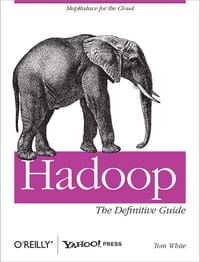
Hadoop: The Definitive Guide
出版时间
2009-01-01
ISBN
9780596521998
评分
★★★★★
书籍介绍
这本书最耐人寻味的地方,恰恰是它作为「权威入门」的价值与「迅速过时」的命运之间的张力。读者反复提到:它把 Hadoop 的来龙去脉、HDFS 与 MapReduce 的设计取舍讲得极清楚——namenode 与 datanode 的主从结构、数据本地性优化、分块为何要大于磁盘块、分区如何按 hash 收敛到单一 partition,都讲得有理有据。正因如此,它成为零基础者快速建立系统观的捷径。然而大量短评也毫不留情地指出:第二版、第三版覆盖的配置早已过时,「挫逼」的吐槽甚至指向 Java 实现。因此它真正的读者定位是:想先建立整体架构认知、再自行追新技术演进的人,而非指望它提供最新操作手册的人。把它当作理解分布式系统思想的「地图」,而非「实时导航」,它的生命力才真正成立。
AI导读
核心看点
- 全面解析Hadoop架构,涵盖HDFS与MapReduce核心原理
- 深入讲解分布式系统构建,提供集群搭建与运维实战指南
- 通过案例研究展示如何利用Hadoop解决海量数据处理难题
读者共识
- 公认的经典入门教材,对Hadoop来龙去脉介绍清晰透彻
- 英文原版内容详实权威,但中文版翻译被广泛吐槽不靠谱
- 适合初学者建立知识体系,但需配合实践以克服理解困难
精彩摘录
- "* The architecture of HDFS is described in “The Hadoop Distributed File System” by Konstantin Shvachko, Hairong Kuang, Sanjay Radia, and Robert Chansler (Proceedings of MSST2010, May 2010, http:// storageconference.org/2010/Papers/MSST/Shvachko.pdf). † “Scaling Hadoop to 4000 nodes at Yahoo!,” http:"
- "在许多情况下,可以视Mapreduce为关系型数据库管理系统的补充。MapReduce比较适合以批处理的方式处理需要分析整个数据集的问题,尤其是即席分析。RDBMS适用于点查询和更新,数据集被索引后,数据库系统能够提供低延迟的数据检索和快速的少量数据更新。MapReduce适合数据一次写入、多次读取的应用,而关系型数据库更适合持续更新数据集."
- "MapReduce is a programming model for data processing. MapReduce works by breaking the processing into two phases: the map phase and the reduce phase. Each phase has key-value pairs as input and output, the types of which may be chosen by the programmer. The programmer also specifies two functions: t"
- "Hadoop divides the input to a MapReduce job into fixed-size pieces called input splits, or just splits. Hadoop creates one map task for each split, which runs the userdefined map function for each record in the split. Hadoop does its best to run the map task on a node where the input data resides in"
- "HDFS is a filesystem designed for storing very large files with streaming data access patterns(write-once, read-many-times pattern), running on clusters of commodity hardware. HDFS blocks(>64M) are large compared to disk blocks, and the reason is to minimize the cost of seeks. Map tasks in MapReduce"
- "One important aspect of this design is that the client contacts datanodes directly to retrieve data and is guided by the namenode to the best datanode for each block. This design allows HDFS to scale to a large number of concurrent clients, since the data traffic is spread across all the datanodes i"
- "As the client writes data (step 3), DFSOutputStream splits it into packets, which it writes to an internal queue, called the data queue . The data queue is consumed by the Data Streamer , whose responsibility it is to ask the namenode to allocate new blocks by picking a list of suitable datanodes to"
- "HDFS Federation, introduced in the 0.23 release series, allows a cluster to scale by adding namenodes, each of which manages a portion of the filesystem namespace. For example, one namenode might manage all the files rooted under /user , say, and a second namenode might handle files under /share . T"
用户评论
Hadoop挫逼一定是Java的错!
comprehensive and informative, though, outdated.
太多细节 英文第三版
我读过最淫荡的技术书籍,虽然第三版覆盖的配置都已经过时了
Introduction to Hadoop// http://proquest.safaribooksonline.com/book/software-engineering-and-development/9781449328917
MapReduce讲的挺详细的,其他组件或框架或许还要找对应书籍再深入看,算是大数据框架入门了。
第三版
英文版和中文版的评价能分开吗
一个时代的结束
大概13年左右看的 当初学的这个之后的工作中派上了用场
大致翻过。谷歌三驾马车的开源实现,讲得比论文详细。
O'Reilly Media, Inc.的其他书籍查看全部
 Hands-On Generative AI with Transformers and Diffusion Model
 AI and Machine Learning for Coders
 Fluent Python, 2nd Edition
 iOS 14 Programming Fundamentals with Swift
 Automating System Administration with Perl
 Java Message Service
下载
收藏