
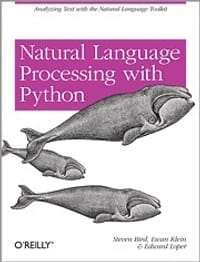
Natural Language Processing with Python
出版时间
2009-07-10
ISBN
9780596516499
评分
★★★★★
书籍介绍
这本书最独特的地方,在于它把Python和自然语言处理绑在一起教:不懂Python也能读,学NLP的同时把语言也学会了。它不是理论教科书,而是以NLTK库为骨架的实践手册——从词性标注、命名实体识别到语境相似度,读者通过大量可运行的示例程序亲手处理大规模非结构化文本。短评里反复出现的,是它"编排合理、实用可读",让人"有点喜欢上了自然语言处理"。但也有人遗憾:理论讲得少,更多是库的使用指南。因此它适合想快速上手、边做边学的实践者,而非寻求算法原理的研究者。唯一的小遗憾是书中用的是Python 2,不过官方网页版已免费更新到第3版。
AI导读
核心看点
- 基于Python与NLTK库,系统讲解自然语言处理核心算法
- 涵盖文本分词、词性标注及命名实体识别等实用技术
- 提供大量代码示例,帮助处理非结构化文本数据
读者共识
- 实例丰富且编排合理,是公认的优秀入门教材
- 对非计算机专业友好,兼顾Python语法与NLP知识
- 部分高级章节难度较大,需结合其他资料深入
精彩摘录
- "A part-of-speech tagger, or POS tagger, processes a sequence of words, and attaches a part of speech tag to each word (don’t forget to import nltk):"
- "Here we see that and is CC, a coordinating conjunction; now and completely are RB, or adverbs; for is IN, a preposition; something is NN, a noun; and different is JJ, an adjective. NLTK provides documentation for each tag, which can be queried using the tag, e.g., nltk.help.upenn_tagset('RB'), or a "
- "Notice that refuse and permit both appear as a present tense verb (VBP) and a noun (NN). E.g., refUSE is a verb meaning “deny,” while REFuse is a noun meaning “trash” (i.e., they are not homophones). Thus, we need to know which word is being used in order to pronounce the text correctly. (For this r"
- "The text.similar() method takes a word w, finds all contexts w1w w2, then finds all words w' that appear in the same context, i.e. w1w'w2."
- "A tagger can also model our knowledge of unknown words; for example, we can guess that scrobbling is probably a verb, with the root scrobble, and likely to occur in contexts like he was scrobbling."
- "Tagged corpora use many different conventions for tagging words. To help us get star- ted, we will be looking at a simplified tagset (shown in Table 5-1)."
- "Example 5-1. Program to find the most frequent noun tags."
用户评论
NLTK 指导书!看了前七章,后面的句法分析没看了
扫了前200页,基本上还啥也没讲呢
后面就开始看不懂了TT
很多非常适合Python实践的例子,但是对我来说我希望得到更多理论上的理解,但是本书更多是基于一个库的实践指导吧
觉得一般...
入门:用python做computational semantics
我读的电子版,从封面看也许不是同一本。个人认为这本有点像教人怎么用package,更像工具书而非入门读物。
神经网络之前的自然语言处理,NLTK工具书,从序列标注到语义分析。一阶逻辑那里不怎么清楚,别的都挺好的。
这好像是我完完整整看完实践过的第一本编程书...惭愧
读了前三章,完全就是nltk说明书和基本的文本处理方法,后面的章节也扫了一眼,感觉介绍的东西过于细节且有些过时。个人所见,目前主流的NLP,已经是基于word embedding representation结合neural network deep learning了,而不是探究grammar,句式结构,单词词性这些了。
O'Reilly Media的其他书籍查看全部
 Developing Apps with GPT-4 and ChatGPT
 Building Knowledge Graphs
 Essential Math for AI
 Running Lean (3/e)
 Quarkus Cookbook
 Learning React 2nd ed.
下载
收藏