
Description
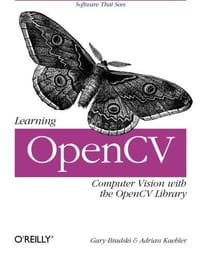
Learning OpenCV puts you right in the middle of the rapidly expanding field of computer vision. Written by the creators of OpenCV, the widely used free open-source library, this book introduces you to computer vision and demonstrates how you can quickly build applications that enable computers to "see" and make decisions based on the data. With this book, any developer or hobbyist can get up and running with the framework quickly, whether it's to build simple or sophisticated vision applications.
Full Description
Learning OpenCV puts you right in the middle of the rapidly expanding field of computer vision. Written by the creators of OpenCV, the widely used free open-source library, this book introduces you to computer vision and demonstrates how you can quickly build applications that enable computers to "see" and make decisions based on the data.
Computer vision is everywhere -- in security systems, manufacturing inspection systems, medical image analysis, Unmanned Aerial Vehicles, and more. It helps robot cars drive by themselves, stitches Google maps and Google Earth together, checks the pixels on your laptop's LCD screen, and makes sure the stitches in your shirt are OK.
OpenCV provides an easy-to-use computer vision infrastructure along with a comprehensive library containing more than 500 functions that can run vision code in real time. With Learning OpenCV, any developer or hobbyist can get up and running with the framework quickly, whether it's to build simple or sophisticated vision applications.
The book includes:
* A thorough introduction to OpenCV
* Getting input from cameras
* Transforming images
* Shape matching
* Pattern recognition, including face detection
* Segmenting images
* Tracking and motion in 2 and 3 dimensions
* Machine learning algorithms
Hands-on exercises at the end of each chapter help you absorb the concepts, and an appendix explains how to set up an OpenCV project in Visual Studio. OpenCV is written in performance optimized C/C++ code, runs on Windows, Linux, and Mac OS X, and is free for commercial and research use under a BSD license.
Getting machines to see is a challenging but entertaining goal. If you're intrigued by the possibilities, Learning OpenCV gets you started on building computer vision applications of your own.
Gary Bradski博士是斯坦福大学人工智能实验室的顾问教授,也是Willow Garage公司机器人学研究协会的资深科学家。
Adrian Kaehler博士,Applied Minds公司的资深科学家,从事机器学习、统计建模、计算机视觉和机器人学方面的研究。
- OpenCV创始人亲笔撰写,权威解读计算机视觉
- 结合算法原理与代码实例,知其然更知其所以然
- 按应用领域分类,系统讲解图像处理与机器视觉
- 希望快速入门计算机视觉的开发者与爱好者
- 需要系统理解OpenCV底层逻辑的程序员
- 从事图像处理或机器视觉研究的科研人员
- 注意书中接口基于旧版本,需结合官方文档更新
- 建议先掌握图像矩阵基础,再深入后续章节
- 可将本书作为工具书,按需查阅特定函数用法
- 内容全面经典,是学习OpenCV的优质入门教材
- 讲解清晰透彻,有助于深入理解算法核心原理
- 部分代码示例存在瑕疵,阅读时需注意甄别
本导读基于书籍简介、目录、原文摘录、短评和书评生成,不等同于全文精读。
- "Computer vision has a rich future ahead, and it seems likely to be one of the key enabling technologies for the 21st century. Likewise, OpenCV seems likely to be (at least in part) one of the key enabling technologies for computer vision. Endless opportunities for creativity and profound contributio"
- "OpenCV倾向于支持鉴别式算法,而不倾向于产生式算法。虽然这两者的区别不是非常清晰,但是鉴别式模型在根据给定的数据做出预测上有优势,而产生式模型则是在为你提供更强大的数据表达或者有条件地生成新数据时有优势。"
- "These sequences are sequences of points; more precisely, they are contours—the actual topic of this chapter. The key thing to remember about contours is that they are just a special case of sequences."
- "writing efficient code is often very difficult to do in a modular way"
 Developing Apps with GPT-4 and ChatGPT
 Building Knowledge Graphs
 Essential Math for AI
 Running Lean (3/e)
 Quarkus Cookbook
 Learning React 2nd ed.