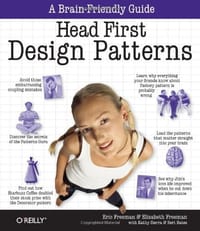
Head First Design Patterns

Elisabeth Freeman

出版时间

2004-11-01

ISBN

9780596007126

评分

★★★★★
书籍介绍

You're not alone. At any given moment, somewhere in the world someone struggles with the same software design problems you have. You know you don't want to reinvent the wheel (or worse, a flat tire), so you look to Design Patterns--the lessons learned by those who've faced the same problems. With Design Patterns, you get to take advantage of the best practices and experience of others, so that you can spend your time on... something else. Something more challenging. Something more complex. Something more fun. You want to learn about the patterns that matter--why to use them, when to use them, how to use them (and when NOT to use them). But you don't just want to see how patterns look in a book, you want to know how they look "in the wild". In their native environment. In other words, in real world applications. You also want to learn how patterns are used in the Java API, and how to exploit Java's built-in pattern support in your own code. You want to learn the real OO design principles and why everything your boss told you about inheritance might be wrong (and what to do instead). You want to learn how those principles will help the next time you're up a creek without a design paddle pattern. Most importantly, you want to learn the "secret language" of Design Patterns so that you can hold your own with your co-worker (and impress cocktail party guests) when he casually mentions his stunningly clever use of Command, Facade, Proxy, and Factory in between sips of a martini. You'll easily counter with your deep understanding of why Singleton isn't as simple as it sounds, how the Factory is so often misunderstood, or on the real relationship between Decorator, Facade and Adapter. With Head First Design Patterns, you'll avoid the embarrassment of thinking Decorator is something from the "Trading Spaces" show. Best of all, in a way that won't put you to sleep! We think your time is too important (and too short) to spend it struggling with academic texts. If you've read a Head First book, you know what to expect - a visually-rich format designed for the way your brain works. Using the latest research in neurobiology, cognitive science, and learning theory, Head First Design Patterns will load patterns into your brain in a way that sticks. In a way that lets you put them to work immediately. In a way that makes you better at solving software design problems, and better at speaking the language of patterns with others on your team.

AI导读
核心看点
  • 本书彻底颠覆传统设计模式教材的枯燥说教,采用Head First系列特有的视觉化、互动式教学法。通过大量漫画、对话和真实场景案例,将抽象的GoF设计模式转化为可理解的日常逻辑,帮助读者在轻松氛围中掌握策略、观察者、装饰器等核心模式的本质与应用边界。
  • 深入讲解面向对象设计的核心原则,如针对接口编程而非实现、分离变化与不变部分、好莱坞原则及开闭原则。书中不仅展示模式代码,更强调为何使用这些原则,引导读者建立松耦合、高内聚的系统架构思维,避免陷入为了模式而模式的误区。
  • 强调设计模式在真实环境中的‘野生’应用,而非孤立的概念背诵。通过逐步重构代码的过程,展示如何识别设计坏味道并应用模式解决实际问题。虽然篇幅冗长且包含大量幽默废话,但其对新手友好的引导方式能有效降低学习门槛,培养正确的软件设计直觉。
适合谁读
  • 适合Java编程初学者及希望系统学习设计模式的开发者。对于被GoF《设计模式》晦涩理论劝退的读者,本书提供了极佳的替代方案。它不要求读者具备深厚的架构经验,而是通过循序渐进的案例,帮助新手跨越从‘能写代码’到‘写好代码’的认知鸿沟,建立规范的设计思维。
  • 适合需要快速理解设计模式应用场景的在校学生或转行人员。书中内容虽冗长,但核心知识点清晰,配合生动的插图和通俗的语言,能有效缓解学习焦虑。然而,对于追求高效、反感冗余信息的高级工程师,本书可能因废话过多而显得效率低下,不建议作为快速查阅手册。
  • 适合对软件工程最佳实践感兴趣,但缺乏实际项目重构经验的读者。本书通过模拟真实开发中的错误与修正过程,让读者体验设计原则的价值。但需注意,书中代码基于Java,其他语言开发者需自行映射概念,且部分读者反映其幽默风格令人不适,请根据个人阅读偏好谨慎选择。
读前提醒
  • 阅读前需做好心理准备,本书篇幅巨大且包含大量无关紧要的幽默对话和重复性解释。建议不要逐字阅读所有废话,而是跳过冗余部分,重点关注代码示例、设计原则总结及模式应用场景。若感到烦躁,可尝试快速浏览章节结构,仅提取核心概念,避免陷入无效阅读。
  • 切勿将本书作为设计模式的权威参考手册或速查指南。书中的案例旨在教学而非生产级最佳实践,部分代码可能存在缺陷或不符合现代编程规范。读者应结合官方文档、现代框架源码及实际项目经验进行验证,避免被书中过时的实现方式误导,需具备批判性思维。
  • 建议配合实际编码练习同步阅读。书中强调‘不要只看书’,读者应在理解每个模式后,立即在自有项目中尝试重构或模拟实现。同时,注意区分书中强调的‘原则’与‘模式’,优先掌握开闭原则、依赖倒置等底层逻辑,而非死记硬背模式模板,以免陷入教条主义。
读者共识
  • 读者普遍认可本书在降低设计模式学习门槛方面的巨大贡献,认为其比GoF原著更易读、更友好。然而,绝大多数评论指出书中存在严重的冗余问题,大量篇幅被无意义的幽默、重复解释和废话占据,导致阅读体验极差,甚至引发部分读者的强烈反感与痛苦。
  • 尽管形式备受争议,但读者一致认为本书在传达设计原则和正确思维方法上具有不可替代的价值。许多用户表示,虽然阅读过程痛苦,但最终确实理解了模式背后的逻辑,并提升了代码设计能力。这种‘痛并快乐着’的评价反映了其在教育有效性上的成功,尽管代价是极高的时间成本。
  • 社区共识认为,本书不适合作为进阶参考或快速查询工具,其冗长风格不适合有经验的开发者。但对于零基础新手,它是入门设计模式的唯一推荐读物之一。读者强烈建议:若决定阅读,请保持耐心,跳过废话,聚焦核心代码与原则,并警惕书中可能存在的过时或错误实现,需结合其他资源交叉验证。

本导读基于书籍简介、目录、原文摘录、短评和书评生成,不等同于全文精读。

精彩摘录
  • "針對接口編程,而不是針對實現編程"
  • "針對超類型編程"
  • "The Hollywood Principle Don't call us, we'll call you. > The high-level components give the low-level components a "don't call us, we'll call you" treatment. > The Hollywood Principle gives us a way to prevent "dependency rot". (依赖腐败)"
  • "The connection between the Hollywood Principle and the Template Method Pattern is probably somewhat apparent: when we design with the Template Method Pattern, we're telling subclasses, "don't call us, we'll call you.""
  • "分开变化和不会变化的部分 针对接口(超类型)编程,而不是针对实现编程"
  • "开放-关闭原则:类应该对扩展开放,对修改关闭。"
  • "系統中的某部分改變不會影響其他部分"
  • "觀察者模式 = 出版者 + 訂閱者。"
用户评论
Gang of Four! OOP奇葩。newbie最好别看...
脑疼。
chu xue zhe, fei yin fen, fei genius, fei zi da kuang, bi du!
设计模式的最佳入门书吧,对于新手而言,它比四人帮的书要好懂的多,Proxy和Factory Pattern的讲解也比wiki等几个网站的讲解要好。
寓教于乐
Chapter 7, Adapter.
新手友好
每个想做Architekt但又不爱读字的人都值得读一读。简单易懂,还引导思考,SW Architekt界的幼儿启蒙书!
真的读不下去啰里八嗦的书。
通俗易懂,扫盲了//1.31立个flag,春节假期把这本看完
收藏