
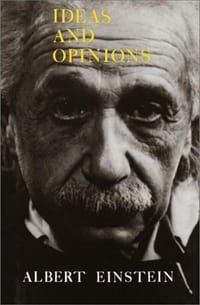
书籍介绍
这并不是一本教人如何成为科学家的书。翻开它,你会先被爱因斯坦长句里层层叠叠的同位语绊住脚步——那是上世纪中叶特有的、近乎执拗的思辨文体。但真正留住读者的,是他跳出物理实验室后对世界的持续发问:科学能告诉我们
作者简介
Albert Einstein is undoubtedly one of the most fascinating and influential figures of the modern era. As a preeminent physicist, he radically transformed our understanding of the universe. As an ardent humanist, he took an active and outspoken stance on the significant political and social issues of his time. As a committed Jew, he advocated a distinctive moral role for the Jewish people.
Albert Einstein's contribution to modern physics is simply unique. His scientific career was a constant quest for the universal and immutable laws, which govern the physical world. His theories spanned the fundamental questions of nature, from the very large to the very small, from the cosmos to sub-atomic particles. He overturned the established concepts of time and space, energy and matter. Einstein played a crucial role in establishing the two pillars of 20th century physics: he was the father of the theory of relativity and a major contributor to quantum theory.
Einstein was a theoretical physicist - his only concrete tools being pencil and paper. It has been said that his true tools were a penetrating and intuitive grasp of the workings of the natural world and the "thought experiment" - an intellectual exercise used by physicists to reach a theoretical conclusion from idealized physical processes. Yet, Einstein was not a purely abstract thinker. He grasped the world in concrete images and strove to translate them into words and equations that could be understood by others.
Science was Albert Einstein's first love, yet he always found time to devote tireless efforts to political causes close to his heart. His ardent humanism led him to strive for peace, freedom and social justice. The young Einstein found the authoritarianism and militarism of the German educational system profoundly disturbing. The virulent nationalism and brutality of the First World War served to confirm Einstein's pacifist and internationalist convictions.
In the 1920s, Einstein became an active leader of the international anti-war movement and supported conscientious objection. However, the Nazi rise to power brought about a substantial change in Einstein's position: he began to advocate military preparedness by the European democracies against the threat of Nazism. In this context, Einstein wrote his famous letter to U.S. President Roosevelt in which he urged him to initiate an American nuclear research programme. With the onset of the atomic era, Einstein realized that nuclear weapons were a profound risk to humanity and could bring an end to civilization. During the last decade of his life, he was tireless in his efforts to create effective international cooperation to prevent war.
Throughout his life, Albert Einstein felt a close affinity with the Jewish people. Einstein defined Judaism as a culture with a shared historical past and common ethical values rather than as an institutionalized religion. For him the main values of Judaism were intellectual aspiration and the pursuit of social justice. Like Spinoza, he did not believe in a personal god, but that the divine reveals itself in the physical world. Einstein supported the creation of a homeland for the Jews in Palestine. However, he stipulated that any solution of the Arab-Jewish conflict had to be based on mutual understanding and consent.
Albert Einstein was one of the founders of the Hebrew University of Jerusalem. He served on the University's first Board of Governors and Academic Council. He delivered the University's inaugural scientific lecture and edited its first collection of scientific papers. His unique relationship to this institution found a lasting expression in the bequest of his literary estate and personal papers to the Hebrew University in his Last Will and Testament.
AI导读
核心看点
- 汇集爱因斯坦关于科学、宗教、政治的随笔
- 探讨客观知识与人类终极目标的关系
- 阐述对教育本质及精神发展的深刻见解
读者共识
- 思维深邃广阔,展现伟大心灵的独特视角
- 文字虽具挑战性,但思想极具启发性与力量
- 超越科学范畴,提供关于人生价值的深刻洞见
精彩摘录
- "因为科学方法只能告诉我们事实之间的关系和影响。渴望获得这种客观知识属于人类最高层次的能力,大家肯定不会以为我想贬低人类在这个领域的成就和英勇努力。但同样清楚的是,了解事物是什么并不能直接导向事物应当是什么。对于事物是什么,我们可以有最清晰完整的了解,但依然无法从中导出人类应当追求什么目标。客观知识为我们实现某些目标提供了强有力的工具,但最终目标本身以及实现它的渴望必须有另外的源泉。毫无疑问,只有确立了这样的目标和相应的价值,我们的生存和行动才能获得意义。认识真理本身是美妙的,但这种认识几乎无法充当向导,甚至证明不了对真理本身的渴望的正当性和价值。"
- "如果背后没有一种活生生的精神,一切手段都只是迟钝的工具罢了。但如果心中充满着实现目标的渴望,我们就会有足够的力量找到实现目标的手段,并把它转化为行动。"
- "只要对科学领域的胜利进展有过深切的体验。就会对存在之中显示出来的合理性至为崇敬和感动。通过理解,他从个人愿望和欲求的束缚中完全解放出来,从而对存在之中的庄严理性心生谦卑,这种庄严理性极为深奥,非凡人所能及。但我认为,这种态度正是最高意义上的宗教态度。科学不仅涤净了宗教感情的拟人论糟粕,而且有助于使我们对生活的理解达到宗教的精神境界。 在我看来,人类的精神越是进化,就越可以确定,真正的宗教不是通过对生与死的恐惧,也不是通过盲目信仰,而是通过追求理性知识而达到的。在这个意义,我认为一个教士若想对得起自己崇高的教育使命,就必须成为一位导师。"
- "Sometimes one sees in the school simply the instrument for transferring a certain maximum quantity of knowledge to the growing generation. But that is not right. Knowledge is dead; the school, however, serves the living. It should develop in the young individuals those qualities and capabilities whi"
- "But how shall one try to attain this ideal? Should one perhaps try to realize this aim by moralizing? Not at all. Words are and remain an empty sound, and the road to perdition has ever been accompanied by lip service to an ideal. But personalities are not formed by what is heard and said, but by la"
- "The second-named motive, ambition or, in milder terms, the aiming at recognition and consideration, lies firmly fixed in human nature. With absence of mental stimulus of this kind, human cooperation would be entirely impossible; the desire for the approval of one’s fellow-man certainly is one of the"
- "一个可能的解决方案:学校里取消隔离可以为学生相互了解打开大门,但就其本身而言,它不是根本的解决方法。重要的问题不是简单地把不同种族、不同民族的孩子送入同一个学校;他们到那里以后的情况才是至关重要的。正像我们所看到的,如果那里的气氛竞争性很强,相互接触的结果可能会使从一开始就存在的紧张气氛更加紧张。 在竞争这一过程中,学生们学到了几件事:第一,他们知道了这个教室里只有一个专家,就是教师。他们也知道教师的每个问题只有一个正确的答案,即教师脑子里已有的答案。学生的任务就是想象出教师期望的那个答案。学生们还知道只有积极地表现出自己多么机灵、聪明、整齐、清洁、举止端庄才能使老师高兴、才能得到奖励。如果他"
- "If the second goal, that is, the possibility of the spiritual development of all individuals, is to be secured, a second kind of outward freedom is necessary. MAN SHOULD NOT HAVE TO WORK FOR THE ACHIEVEMENT OF THE NECESSITIES OF LIFE TO SUCH AN EXTENT THAT HE HAS NEITHER TIME NOR STRENGTH FOR PERSON"
用户评论
爱因斯坦所在的那个年代(二战前后)对世界(文化、科技、和平、宗教、物理..)的认知和想法。整本书都是长难句,强迫症似的一定要多用几个同位语显示高级,两句话就够了一大段。Great mind anyhow.
impressive
物理学相对论什么的就先不看了吧,however, other writings on religion, science, education and humanity are brilliant as are from a great mind.
“The value of a man, however, should be seen in what he gives and not in what he is able to receive.”
挑了一些读,写的蛮好的。有机会还可以再找来读一读,想一想。
没什么内容。。。
两年前读的我热泪盈眶。
求书
收藏