
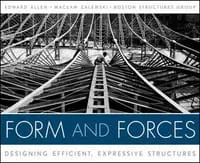
Form and Forces
出版时间
2009-10-23
ISBN
9780470174654
文件格式
评分
★★★★★
内容简介
Here, in one volume, is all the architect needs to know to participate in the entire process of designing structures. Emphasizing bestselling author Edward Allen's graphical approach, the book enables you to quickly determine the desired form of a building or other structure and easily design it without the need for complex mathematics. This unique text teaches the whole process of structural design for architects, including selection of suitable materials, finding a suitable configuration, finding forces and size members, designing appropriate connections, and proposing a feasible method of erection. Chapters are centered on the design of a whole structure, from conception through construction planning.
AI 导读
编辑书评
- 《Form and Forces》的价值在于它重新定义了建筑师与结构工程师的关系。它不是教你怎么算出钢筋用量,而是教你怎么像艺术家一样思考力的流动。其独到之处在于用达芬奇时代的图解法解决现代复杂形态问题,证明了简单几何原理足以驾驭高深结构。局限在于其对常规多层框架结构的忽视,以及高昂的阅读成本。但它无疑是打破国内建筑教育“重形式轻逻辑”弊病的最佳解毒剂,值得每一位严肃对待空间生成的建筑师精读。
- 相较于同类结构概念书籍,本书胜在“全流程闭环”与“案例驱动”。它没有停留在理论层面,而是从概念到施工细节一以贯之,提供了可复制的设计范式。虽然文字量大、图片密集,看似劝退,实则是对深度思考者的筛选。对于急需提升方案阶段结构把控能力的从业者,这是一本能直接转化为生产力的工具书。建议将其作为长期案头参考,而非一次性读物,每次遇到设计瓶颈时翻阅,往往能获得意想不到的启发。
核心看点
- 本书颠覆了传统结构教材“先定形后计算”的逻辑,确立了“力流引导形态”的设计哲学。通过图解静力学(Graphic Statics)这一古老而直观的方法,作者展示了如何从受力路径出发推导建筑形式,而非将结构视为支撑既定造型的附属品。这种视角让建筑师在方案初期就能介入结构设计,实现美学与力学的真正统一。
- 内容编排以完整案例贯穿始终,涵盖从概念构思、材料选择、构件尺寸确定到节点设计及施工规划的全流程。不同于碎片化的知识点罗列,本书强调系统性思维,特别是针对大跨度悬挂结构、薄壳等复杂体系,提供了无需高阶数学即可掌握的定性分析与定量优化方法,极具实操指导意义。
- 作为波士顿结构组(Boston Structures Group)及MIT相关课程的经典配套教材,本书填补了国内建筑教育中“结构概念设计”的空白。它不追求繁琐的公式推导,而是致力于培养直觉性的结构判断力,帮助读者建立对力传递路径的敏感度,是连接建筑创意与工程可行性的关键桥梁。
读者共识
- 读者普遍高度评价本书的“图形化”与“直觉性”,认为它是真正的“建筑师需要的结构书”。相比国内教材侧重计算验证,本书更强调设计生成,被多次提及为MIT及哈佛GSD等名校的经典教材,具有极高的学术地位和实践价值,常被用于辅助实际工程项目(如机场设计)。
- 主要争议点集中在“厚度”与“价格”上。许多读者感叹原版过于厚重且售价高昂,导致购买压力大;同时,部分读者指出书中对高层结构着墨较少,主要集中在大跨度领域,这可能让关注常规住宅或办公建筑的读者感到内容覆盖不全,需搭配其他书籍使用。
- 读者共识还体现在对“常读常新”的认可。尽管初读可能因语言或概念陌生而感到困难,但一旦入门,会发现其逻辑清晰、浅显易懂。多位读者表示,该书不仅解决了技术疑问,更重塑了结构思维,是提升设计品质的利器,值得反复翻阅并做笔记。
精彩摘录
- "We have selected rods rather than cables because these bridges are small and the loads to be supported are correspondingly low. Cables, if we were to use them, would be very small in diameter, which would make them vulnerable to vandalism."
- "...Thus, when we design a cable structure, our task is not to invent a form for the cable, but by means of the force polygon/funicular polygon pair to discover what shapes the cable will take under the assumed condition of support and loading, and to find among these shapes the one that best suits o"
- "On any force polygon/funicular polygon sysem subjected to vertical loads only, a ray drawn from the pole parallel to the closing string will divide the load line into the vertical components of the reactions at the ends of the funicular polygon."
- "Every parabola that is cut through by a closing string, regardless of whether the string is horizontal or sloping, has the property that lines tangent to the parabola at the points at which it intersects the closing string will intersect each other on the vertical centerline of the parabola. Further"
读者评论
打分都这么高。终于一睹真面目。好厚。这次来不及看了。原版太贵,真的买不起。
好书,相当于一个设计师手记,讲的比结构力学清楚多了
机场要用
John Ochsendorf 結構課配套教材。
Block教授在MIT的著作.....一边做练习一边看此书
结构感。振奋地时候会跑着读不求甚至解
学习力流规划,图解是其次
足够入门,足够浅显,一个章节一个典型案例,一点点从草图到建成,简单有简单的「弱智」提问,复杂也会考虑细部和施工效率。如果国内能按这套逻辑教学就好了!
实用,详尽
戳一下我们教科书。个人感觉越往后有点雷同。不过这种尺规画图的方法还是有意思的。有助于理解力的原理。