
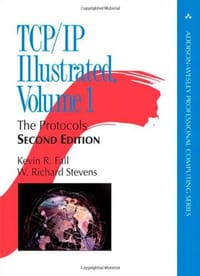
TCP/IP Illustrated, Volume 1 (2nd Edition)
出版时间
2011-09-19
ISBN
9780321336316
评分
★★★★★
书籍介绍
这本书最引争议之处,恰是它最核心的价值:它不满足于告诉你TCP/IP“怎么用”,而是执拗地追问“为什么这样设计”。第二版作者Kevin Fall引入了wireshark抓包分析,让协议在Linux、Windows、macOS的真实交互中显形——三次握手、滑动窗口、ARP应答如何直达而非广播,都成了可被观察的现象。读者反馈两极分化:有人嫌它“不够易懂”“对网络工程师又远远不够”,也有人称其为“网络开发必读经典”。它显然不适合当作网络入门读物,却适合已经摸到协议门槛、渴望看清每一层封装与分用背后机理的人。若你愿意从理论走向代码,从“知道”走向“理解”,它会是你案头那本又厚又沉、却值得反复查阅的伙伴。
作者简介
Kevin R. Fall, Ph.D., has worked with TCP/IP for more than twenty-five years, and served on the Internet Architecture Board. He co-chairs the Internet Research Task Force’s Delay Tolerant Networking Research Group (DTNRG), which explores networking in extreme and performance-challenged environments. He is an IEEE Fellow.
W. Richard Stevens, Ph.D. (1951-1999), was the pioneering author who taught a generation of network professionals the TCP/IP skills they’ve used to make the Internet central to everyday life. His best-selling books included all three volumes of TCP/IP Illustrated (Addison-Wesley), as well as UNIX Network Programming (Prentice Hall).
AI导读
核心看点
- 本书是TCP/IP协议栈的权威指南,基于Stevens经典第一版全面更新,由Kevin Fall撰写,深入解析现代Linux、Windows及Mac OS环境下的协议实现细节,涵盖从底层以太网帧到高层应用协议的全栈技术。
- 书中通过大量Wireshark抓包实例和真实网络环境下的代码分析,直观展示协议交互过程,帮助读者理解IP路由、TCP滑动窗口、拥塞控制等核心机制的实际运行逻辑,而非仅停留在理论层面。
- 内容极度详尽且专业,不仅解释协议规范,更揭示协议在异常条件下的行为反应及潜在漏洞,适合需要深入理解网络底层原理、进行网络故障排查或开发高性能网络应用的资深技术人员参考查阅。
读者共识
- 本书被公认为网络领域的圣经级著作,内容权威、详实,对协议机制的解析无人能出其右。但读者普遍反映其篇幅巨大、细节过多,不适合初学者入门,仅适合作为高级参考手册或特定问题查询工具使用。
- 中文版翻译质量极差,存在大量低级错误、术语误译及未审校痕迹,严重损害阅读体验。读者强烈建议购买英文原版,或在使用中文版时务必对照英文原文,以免被错误译文误导,造成技术理解偏差。
- 尽管内容极具价值,但因其过于深入和枯燥,多数读者表示无法完整读完,且读后容易遗忘。建议读者保持敬畏之心,不要试图‘读完’,而应将其视为案头必备的工具书,在实际工作中遇到瓶颈时再翻查对应章节。
精彩摘录
- "ARP应答是直接送到请求端主机的,而是广播的。"
- "The ARP reply is thus sent directly to the requesting host; it is not ordinarilly broadcast (see Section 4.8 for some cases where this rule is altered)."
- "internet这个词第一个字母是否大写决定了它具有不同的含义。internet意思是用一个共同的协议族把多个网络连接在一起。而Internet指的是世界范围内通过TCP/IP互相通信的所有主机集合(超过1 0 0 万台)。 Internet是一个internet,但internet不等 于Internet。"
- "IP has a simple error handling algorithm: throw away the datagram and try to send an ICMP message back to the source."
- "以太网数据帧的物理特性是其长度必须在4 6~1 5 0 0字节之间,而数据帧在进入每一层协议栈的时候均会做一些封装。"
- "当目的主机收到一个以太网帧时,就在协议栈中从底向上升,同时去掉各层协议加上的报文首部。每层协议盒都要去检查报文首部的协议标识,以确定接收数据的上层协议。这个过程称作分用。"
- "IP路由选择是逐跳进行的。IP并不知道到达任何目的的完整路径(当然,除了那些与主机直接相连的)。所有的IP路由选择只为数据报传输提供下一站路由器的I P地址。它假定下一站路由器比发送数据报的主机更接近目的,而且下一站路由器与该主机是直接相连的。 IP路由选择主要完成以下这些功能: 1) 搜索路由表,寻找能与目的IP地址完全匹配的表目(网络号和主机号都要匹配)。如果 找到,则把报文发送给该表目指定的下一站路由器或直接连接的网络接口(取决于标 志字段的值)。 2) 搜索路由表,寻找能与目的网络号相匹配的表目。如果找到,则把报文发送给该表目 指定的下一站路由器或直接连接的网络接口(取决于标志字段的值"
- "无连接这个术语的意思是IP并不维护任何关于后续数据报的状态信息。每个数据报的处理是相互独立的。这也说明,IP数据报可以不按发送顺序接收。"
用户评论
Stevens的书,精品。
终于拜读此传奇名作,此生无憾矣!好处:IP是联系历史讲网络的最佳典范,TCP用6章250页讲得清楚。不足:存在罗列RFC、过于细节等不符合“illustrated”的段落。
Purchased in Oct. 2013, but since then it was put under my display device, as of its amazing thickness. What a shameful abuse. In the past year I got lots of puzzle in my daily work on router and firewall throughput tuning, then I realized that I must read it systematicly. So I picked it up again. It will reside on my desk for a long time.
传说中那本读完就可以当黑客的书。
只看了tcp部分。不过看完理论,就该看代码了。
这本书讲解的内容,对应用开发者来说已经很深入了,不过对网络工程师来说又远远不够……
TCP/UCP/IP,sliding window,握手
如果能少写一些琐碎的细节就更好了
网络开发必读经典。
只读了自己需要的部分
Addison-Wesley Professional的其他书籍查看全部
 Domain-Driven Design Distilled
 Learning to Program
 Real-Time 3D Rendering with DirectX and HLSL
 The CERT® C Coding Standard, Second Edition
 OpenGL ES 3.0 Programming Guide
 Advanced Programming in the UNIX Environment, 3rd Edition
求书
收藏