
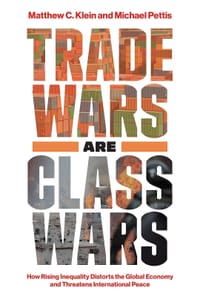
Trade Wars Are Class Wars
出版时间
2020-05-19
ISBN
9780300244175
评分
★★★★★
书籍介绍
这本书最锋利的地方,在于把贸易战从'国家之间的较量'重新拉回到'国家内部的较量'。读者反复提及的核心洞见是:所谓贸易摩擦,本质是各国国内富人借政策优势挤压普通工人和退休者的结果——中国、德国靠抑制消费制造过剩、向全球倾销产能,美国则靠美元特权吸收世界的储蓄剩余。它不满足于解释'发生了什么',而是追问'钱如何被筹集、如何被花掉',由此判断失衡是健康还是危险。不少读者盛赞前三章堪称贸易经济学的工具书,但从'更平等才能更少冲突'的结论看,这本书真正适合的是那些不愿接受'国家利益'这一笼统说法、想看清财富如何在国与国、阶级与阶级之间流动的读者。
作者简介
Matthew C. Klein is the economics commentator at Barron’s. He lives in San Francisco, CA. Michael Pettis is professor of finance at Peking University’s Guanghua School of Management and a senior fellow at the Carnegie Endowment for International Peace. He lives in Beijing.
精彩摘录
- "On average, Germans are richer than almost anyone else in Europe. The average German is about 50 percent richer than the average Italian and twice as wealthy as the average Spaniard. The distribution of wealth is so unequal in Germany, however, that the median German household is far poorer than the"
用户评论
A deeply problematic book that evades the question of growth in developing countries, as well as the issue of demographics in the so-called surplus countries. It will lend intellectual gravitas to a lot of protectionist measures in the next administration.
可以通过这本书学到很多国际贸易,金融历史和现状的知识。180年前大清国与大英帝国的鸦片战争不是关于鸦片的,而是关于贸易的。鸦片战争只是从贸易矛盾升华到热战的程度,背后是因为贸易的不平衡,双方争夺的是如何成为一个顺差国。而今天的中美的贸易战本质是不同国家由于全球化造成的内部矛盾。贸易战有三方玩家,收益方是资本在全球流动过程中钱生钱的财团和银行获得巨大的利润,另外两个玩家是像中国那样低收入的贸易顺差国家和被压迫的普通人。还有受到失业的压迫以及债务的上升像美国那样的贸易逆差国家的普通人。受益者是跨国财团,受害人是中美两国的普通老百姓。川普当选后是代表美国中低层的人们利益,他们对华尔街那些财团以及全球化造成的负面影响是不满的,这些民众都是不满现状,想要改变。唯一办法是去全球化或逆全球化。
"Despite these moves toward liberalization, the end of the war failed to
restore trade to its pre-1929, much less pre-1913, importance. In fact, crossborder
flows of goods and services relative to global output would not
return to the zenith reached in the 1870s until the 1970s." Shocked me.
论述起来显得不太convincing,很容易被低估,但说出了很多ugly truth,有助于理解当下,实在比很多所谓“严肃的学术著作”强多了。读完想借用Michael Yates的书名叹一句,Can the Working Class(Still) Change the World?
8/10.
读完更悲观了
台版
Kindle
对中美的了解都加深了一点

Yale University Press的其他书籍查看全部
 The Athenaeum
 Why I Am Not a Buddhist
 The Lessons of Tragedy
 The Art of the Bribe
 The Voynich Manuscript
 The Archaeology of Jerusalem
下载
收藏