
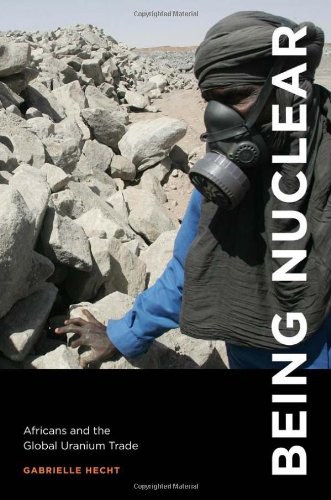
书籍介绍
Uranium from Africa has long been a major source of fuel for nuclear power and atomic weapons, including the bomb dropped on Hiroshima. In 2002, George W. Bush claimed that Saddam Hussein had "sought significant quantities of uranium from Africa" (later specified as the infamous "yellowcake from Niger"). Africa suddenly became notorious as a source of uranium, a component of nuclear weapons. But did that admit Niger, or any of Africa's other uranium-producing countries, to the select society of nuclear states? Does uranium itself count as a nuclear thing? In this book, Gabrielle Hecht lucidly probes the question of what it means for something--a state, an object, an industry, a workplace--to be "nuclear." Hecht shows that questions about being nuclear--a state that she calls "nuclearity"--lie at the heart of today's global nuclear order and the relationships between "developing nations" (often former colonies) and "nuclear powers" (often former colonizers). Nuclearity, she says, is not a straightforward scientific classification but a contested technopolitical one. Hecht follows uranium's path out of Africa and describes the invention of the global uranium market. She then enters African nuclear worlds, focusing on miners and the occupational hazard of radiation exposure. Could a mine be a nuclear workplace if (as in some South African mines) its radiation levels went undetected and unmeasured? With this book, Hecht is the first to put Africa in the nuclear world, and the nuclear world in Africa. Doing so, she remakes our understanding of the nuclear age.
用户评论
读了比较关键的几章,印象非常好。这本书分成两部分,第一部分主要关注非洲铀矿生产和殖民历史、地缘政治的密切关系,其中对于nuclear exceptionalism和nuclear banalization的对立是如何于具体的政治博弈和知识生产中被不同立场、意图的对立方采用的考察尤其精彩;第二部分基本建立在作者在非洲的田野经验之上,展现了围绕着铀矿开采的劳工、医疗、科研等等事业中的文化(符号)政治和现实抗争。
好喜欢这种类型的书~
Z-Library