
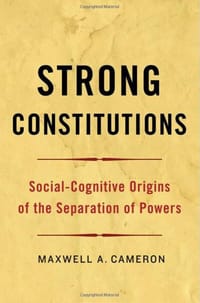
The separation of powers emerged with the spread of literacy, became a central part of constitutional thought with the Gutenberg revolution, and faces unprecedented challenges in the current era of electronic communication. It is linked to social-cognitive changes associated with evolving media of communication. Constitutional states use texts to coordinate collective action, and they do so by creating governmental agencies with specific jurisdiction and competence over distinct types of power. The first, and most familiar, is the power to make decisions backed by legally sanctioned coercion. Two other forms of state power are highlighted: the deliberative power to make procedurally legitimate laws, and the judicial power to interpret and apply laws in particular circumstances. The division of government into three such branches enables state officials and citizens to use written texts—legal codes and documents, including constitutions—along with unwritten rules and conventions to coordinate their activities on larger scales and over longer time horizons. Constitutional states are not weaker because their powers are divided. They are often stronger because they solve collective action problems rooted in speech and communication.
Maxwell Cameron is Associate Professor of Political Science at the University of British Columbia.
显示全部
 The Oxford Handbook of Experimental Syntax (Oxford Handbooks)
 The Fasces
 The Primacy of Doubt
 Landscape and Space
 Future Morality
 Figurines