
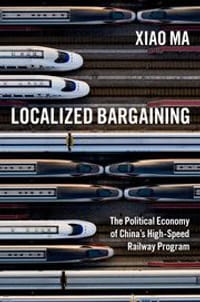
Looks at the rollout of one of the largest infrastructure programs in human history to show how local governments play a complex role.
China's high-speed railway network is one of the largest infrastructure programs in human history. Despite global media coverage, we know very little about the political process that led the government to invest in the railway program and the reasons for the striking regional and temporal variation in such investments. In Localized Bargaining, Xiao Ma offers a novel theory of intergovernmental bargaining that explains the unfolding of China's unprecedented high-speed railway program. Drawing on a wealth in-depth interviews, original data sets, and surveys with local officials, Ma details how the bottom-up bargaining efforts by territorial authorities—whom the central bureaucracies rely on to implement various infrastructure projects—shaped the allocation of investment in the railway system. Demonstrating how localities of different types invoke institutional and extra-institutional sources of bargaining power in their competition for railway stations, Ma sheds new light on how the nation's massive bureaucracy actually functions.
马啸,北京大学政府管理学院助理教授、博士生导师、研究员,华盛顿大学政治学博士。研究领域为比较政治制度、发展政治学和中国政治。已发表和正在进行中的作品从制度主义视角出发,对精英间的权力分享、产权保护、地方治理和公共品提供等问题进行研究。在Political Communication, Security Studies, China Quarterly, Journal of Contemporary China, Journal of East Asian Studies等国内外重要期刊发表论文十余篇。著有Localized Bargaining: The Political Economy of China’s High-Speed Railway Program (牛津大学出版社 Oxford University Press, 2022)。主持...
- "Politics is about “who gets what, when and how”."
 The Oxford Handbook of Experimental Syntax (Oxford Handbooks)
 The Fasces
 The Primacy of Doubt
 Landscape and Space
 Future Morality
 Figurines