
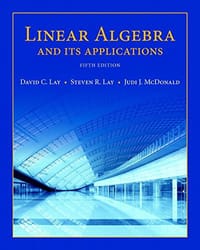
书籍介绍
这本书最鲜明的特点,是把抽象的线性代数概念尽早安置在具体的 Rⁿ 情境里逐步展开:线性无关、生成子空间、向量空间、线性变换这些让无数学生“撞墙”的核心概念,作者选择从直观的几何理解切入,再过渡到严谨的代数表述。读者反复提及,书中丰富的例子与图像、以及经济、工程、计算机等领域的实际应用,让“线性代数是一种必须每天学习的语言”不再只是口号。它适合那些希望先建立几何直觉、再拥抱抽象证明的入门者;但若期望靠刷题速成,或课程大纲与本书结构脱节,可能会感到吃力。它不是万能钥匙,却是一本把“为什么这样定义”讲清楚的工具书。
作者简介
David C. Lay holds a B.A. from Aurora University (Illinois), and an M.A. and Ph.D. from the University of California at Los Angeles. David Lay has been an educator and research mathematician since 1966, mostly at the University of Maryland, College Park. He has also served as a visiting professor at the University of Amsterdam, the Free University in Amsterdam, and the University of Kaiserslautern, Germany. He has published more than 30 research articles on functional analysis and linear algebra. As a founding member of the NSF-sponsored Linear Algebra Curriculum Study Group, David Lay has been a leader in the current movement to modernize the linear algebra curriculum. Lay is also a coauthor of several mathematics texts, including Introduction to Functional Analysis with Angus E. Taylor, Calculus and Its Applications, with L. J. Goldstein and D. I. Schneider, and Linear Algebra Gems–Assets for Undergraduate Mathematics, with D. Carlson, C. R. Johnson, and A. D. Porter. David Lay has received four university awards for teaching excellence, including, in 1996, the title of Distinguished Scholar—Teacher of the University of Maryland. In 1994, he was given one of the Mathematical Association of America’s Awards for Distinguished College or University Teaching of Mathematics. He has been elected by the university students to membership in Alpha Lambda Delta National Scholastic Honor Society and Golden Key National Honor Society. In 1989, Aurora University conferred on him the Outstanding Alumnus award. David Lay is a member of the American Mathematical Society, the Canadian Mathematical Society, the International Linear Algebra Society, the Mathematical Association of America, Sigma Xi, and the Society for Industrial and Applied Mathematics. Since 1992, he has served several terms on the national board of the Association of Christians in the Mathematical Sciences.
Steven R. Lay began his teaching career at Aurora University (Illinois) in 1971, after earning an M.A. and a Ph.D. in mathematics from the University of California at Los Angeles. His career in mathematics was interrupted for eight years while serving as a missionary in Japan. Upon his return to the States in 1998, he joined the mathematics faculty at Lee University (Tennessee) and has been there ever since. Since then he has supported his brother David in refining and expanding the scope of this popular linear algebra text, including writing most of Chapters 8 and 9. Steven is also the author of three college-level mathematics texts: Convex Sets and Their Applications, Analysis with an Introduction to Proof, and Principles of Algebra. In 1985, Steven received the Excellence in Teaching Award at Aurora University. He and David, and their father, Dr. L. Clark Lay, are all distinguished mathematicians, and in 1989 they jointly received the Outstanding Alumnus award from their alma mater, Aurora University. In 2006, Steven was honored to receive the Excellence in Scholarship Award at Lee University. He is a member of the American Mathematical Society, the Mathematics Association of America, and the Association of Christians in the Mathematical Sciences.
Judi J. McDonald joins the authorship team after working closely with David on the fourth edition. She holds a B.Sc. in Mathematics from the University of Alberta, and an M.A. and Ph.D. from the University of Wisconsin. She is currently a professor at Washington State University. She has been an educator and research mathematician since the early 90s. She has more than 35 publications in linear algebra research journals. Several undergraduate and graduate students have written projects or theses on linear algebra under Judi’s supervision. She has also worked with the mathematics outreach project Math Central http://mathcentral.uregina.ca/ and continues to be passionate about mathematics education and outreach. Judi has received three teaching awards: two Inspiring Teaching awards at the University of Regina, and the Thomas Lutz College of Arts and Sciences Teaching Award at Washington State University. She has been an active member of the International Linear Algebra Society and the Association for Women in Mathematics throughout her career and has also been a member of the Canadian Mathematical Society, the American Mathematical Society, the Mathematical Association of America, and the Society for Industrial and Applied Mathematics.
AI导读
核心看点
- 早期引入抽象概念并循序渐进
- 强调几何直观与代数结合
- 丰富实际应用案例辅助理解
读者共识
- 概念讲解清晰易懂
- 优于国内传统教材
- 适合建立线性代数直觉
精彩摘录
- "我们称一个线性方程组是相容的,若它有一个解或无穷多个解;称它是不相容的,若它无解。"
- "实际上,线性代数是一种语言,必须用学习外语的方法每天学习这种语言,理解每一节的内容并不容易,"
- "习题1.1,第11题,X2+5x3=-5"
目录
1. Linear Equations in Linear Algebra
Introductory Example: Linear Models in Economics and Engineering
1.1 Systems of Linear Equations
1.2 Row Reduction and Echelon Forms
1.3 Vector Equations
显示全部
用户评论
😂
疫情期间懒得看录播就只看书自学也能理解完全的书…给的例子真好啊…15天过完6个chapter还是太恐怖了…让我Block Break的时候再慢慢读完它
线性代数滚出我的世界!!!——我对所有线性代数一视同仁,不单单针对本书。夏校课里记了44面纸的笔记,其中34面出自于此。(Summer 2022)
前7章打基础,第8/9/10三个章节需要重点反复读,当然内容并不基础。
写的很好,概念非常清楚,非常好的入门和工具书,exercise也充足。但是prof没有讲完chapter7+8 ,还得补。(总成绩不是A系列……计算能力渣渣
好教材 国内线代教材完全比不了
我啃完的第一本英文学术原著,但居然比翻译版还要好读得多,翻译版真垃圾。原书很好懂,掌握一些术语单词后,不难理解
用了大概90个小时伴着中文版读完的,遇到中文版蹩脚的地方就读原版这种
前五章打基础,6-8章讲了在实际过程中怎么用,我缺的就是这块知识,如果学数学只是为了刷题,那这时间真不如打会儿游戏
所以这本书,给了我学线性代数的意义,自学一定要把原版也带上!
你可能会关注的书籍
 Linear Algebra and Its Applications (4/e)
 Study Guide for Linear Algebra and Its Applications, 3rd Edition
求书
收藏