
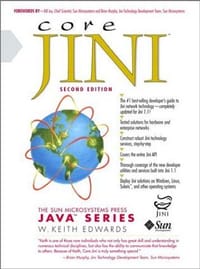
Core Jini (2nd Edition)
出版时间
2000-12-28
ISBN
9780130894083
评分
★★★★★
书籍介绍
A Roadmap
Part I of this book, "Foundations," provides some necessary background reading Jini. This information will be useful for savvy readers who just need to understand Jini, what it does, and how it works. But it's also "required reading" for developers who want to build actual, running Jini programs--the chapters in this part highlight the philosophical differences between Jini and "classical" networked and distributed systems technologies. If you have a good understanding of this material, you're ready to build software that's consistent with the Jini aesthetic.
Chapter 1, "A New Computing Paradigm," looks at the history and motivation of Jini. You'll see how Jini is really the fulfillment of the original Java promise: of collections of software and hardware, working together simply and without administration. This chapter also covers the process of getting and installing the Jini software.
Chapter 2, "Distributed Systems," provides a glimpse at the basics of distributed systems, and how Jini differs from traditional distributed systems software. Even if you're a handy network programmer, you may want to take a look at this chapter. Jini is fairly unique in the distributed systems world, and it's interesting to see the roots of Jini and understand what problems it's good at solving.
Chapter 3, "The Jini Model," introduces the basic concepts in Jini. Fortunately there are very few of these--only five. Understanding these concepts and how they connect to each other will make later reading much easier.
Chapter 4, "Deployment Scenarios," covers some scenarios for deploying Jini services. These are development targets, if you will--ways that you as a developer can deploy Jini code that you write. Jini is perhaps unique in all the Java libraries provided by Sun, in that it is specifically designed to support devices which may not have Java Virtual Machines (JVMs) embedded in them. Jini can be used to connect devices with only limited computational ability, just as it can be used to connect large servers and other machines running full-fledged JVMs. This chapter will help you understand the options available to you if you're designing for Jini.
These first four chapters comprise Part I of this book--they provide a broad introduction to the Jini technology and how it fits into the world. Part II, "Building with Jini," is a very in-depth look at particular aspects of Jini. It is designed for the professional Java developer who is writing new Jini services or building Jini-enabled devices. Some of the chapters in this part are In Depth chapters that dive deeply into a particular aspect of the Jini technology. Others are structured around large examples that show Jini being applied to real problems.
Chapter 5, "Getting Started with Jini," begins with a series of programs designed to introduce you to the core Jini concepts. This series is a set of "Hello, World" style programs that are evolved to illustrate ideas such as lookup, discovery, leasing, and remote events. This chapter is your first introduction to building Jini software from scratch, and covers almost all the basic Jini ideas, as well as an example of using the RMI activation framework.
Chapter 6, "In Depth: Discovery," is an in-depth chapter looking at Jini's discovery protocols. These are the means by which Jini services notify the world of their existence, and Jini client applications learn about the clusters or "communities" of services that are available to them. We'll look under the hood at these protocols--understanding what's really going on there is key to understanding how to use them effectively. By the end of this chapter you should understand these protocols well enough to be able to implement them "by hand" if you need to.
Chapter 7, "Using Attributes to Describe Services," talks about the Jini notion of attributes . Attributes are objects that can be associated with services to provide descriptive information about them, or even provide additional functionality (such as user interfaces) to extend the behavior of services. This chapter talks about how to use attributes, and how the Jini attribute model meshes nicely with JavaBeans.
Chapter 8, "In Depth: Using Lookup Services," moves on to the next major phase in a Jini application's life cycle, the use of the Jini lookup service. Lookup is how applications learn about particular services within a particular community. In this in-depth chapter, you'll see how both clients and services use lookup, and learn how to use some high-level "convenience" APIs to simplify the responsibilities of services with regard to lookup. We'll pay special attention to the issues around federating and connecting Jini communities into larger structures.
At this point you should understand the basics of what you need to know to build a very functional and useful Jini client application that can participate in the discovery and lookup process, and allow you to find and browse an
Prentice Hall PTR的其他书籍查看全部
求书
收藏