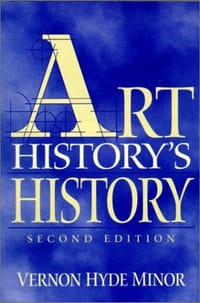
Art History's History - Vernon Hyde Minor

Art History's History

Vernon Hyde Minor

出版社

Prentice Hall

出版时间

2000-07-27

ISBN

9780130851338

评分

★★★★★
书籍介绍
From Library Journal The current discipline of art history has undergone a number of changes through the years. This book is an attempt to track the evolution of its methodology and demonstrate why art history has been presented and taught, particularly in American academia. In the course of delineating this history, however, Minor confuses brevity for elegance. He mentions the standard authorities (e.g., Winckelmann, Riegl, Wolfflin, and Fry) and gives succinct coverage of Marxism, feminist theory, deconstruction, and semiotics. Yet, while his abbreviated summaries of the treatment of art from antiquity to the 18th century are good, important points seem to be telescoped and their relevance diminished. In addition, his concluding "Consequences for Art History" is astonishingly short. Meant for students and general readers, this work does not compare favorably with W. McAllister Johnson's Art History: Its Use and Abuse (Univ. of Toronto Pr., 1988), and the growth of the newer methodological approaches is better explained in The New Art History (Humanities Pr., 1988). Paula A. Baxter, NYPL Copyright 1994 Reed Business Information, Inc. --This text refers to an out of print or unavailable edition of this title. Book Description Written in jargon-free, reader-friendly language, this is one of the first volumes to make art historical theory accessible to those at the introductory level. A review of contemporary theory of art history provides readers with lucid prose and concrete examples. Discussion of eighteenth- and nineteenth- century theories that are important to art history offers readers a review of historically important issues in philosophy. Illustrations of well-known works of art show readers how theory has application to images. Art historians and educators. The publisher, Prentice-Hall Humanities/Social Science Written in jargon-free, reader-friendly language, this is one of the first volumes to make art historical theory accessible to those at the introductory level. --This text refers to an out of print or unavailable edition of this title. From the Back Cover Written in jargon-free, reader-friendly language, this is one of the first volumes to make art historical theory accessible to those at the introductory level. A review of contemporary theory of art history provides readers with lucid prose and concrete examples. Discussion of eighteenth- and nineteenth- century theories that are important to art history offers readers a review of historically important issues in philosophy. Illustrations of well-known works of art show readers how theory has application to images. Art historians and educators. Preface to the Second Edition Since this book first appeared in 1994 there has been a surge of interest in the history of art history. A reader interested in these kinds of issues now has any number of books to choose from, and I have tried to incorporate into the appropriate bibliographies newer publications on the historiography of art history. Because there is this continuing and growing concern with theoretical matters and because art historians find it ever more necessary to interrogate (and even to doubt) the hypotheses and suppositions of the so-called discipline of art history, my editors at Prentice Hall and I decided that a new edition of Art History's History was warranted. As much as I was tempted to do so, I have not recast the basic text. It stands essentially as it was in the first edition. I have, however, updated bibliographies, made some corrections of fact, moved around the odd colon or semicolon, and added new material. On the sound advice of one of the readers of the first edition, I have included a discussion of the work of the American critic Clement Greenberg in Chapter 11, "Visual Supremacy: Connoisseurship, Style, Formalism." Because the terms "New Art History" and "visual culture" have received considerable attention in the past decade, I felt that they deserved their own chapter (now Chapter 13). I have also rewritten the chapter previously entitled "From Word to Image: Semiotics and Art History" and have renamed it "Reading Art History: Word, Image, Iconology, Semiotics" (Chapter 15). Although the previous discussion of semiotics remains unaltered, I have added short essays on ut pictura poesis, and on the learned art historian Erwin Panofsky (perhaps the single most potent voice in art history in the twentieth century) and his inculcation into our discipline of the words "iconography" and "iconology." In the final chapter (Chapter 19), I have taken on such embattled but still powerful concepts as influence, originality, and greatness, while making a modest proposal for the adoption of a term quite current in literary theory, "intertextuality." As with the first edition, I have not included footnotes or specific page citations for quotations. The bibliography at the end of each chapter contains the necessary references to artists and texts, however. When the source of the
AI导读
核心看点
  • 梳理艺术史学科方法论的演变历程
  • 聚焦美国学术界对艺术史的呈现方式
  • 涵盖从温克尔曼到后现代主义的理论
适合谁读
  • 艺术史专业初学者
  • 对艺术理论发展感兴趣者
  • 希望了解学科背景的读者
读前提醒
  • 篇幅短小,内容相对浅显
  • 部分理论概括略显简略
  • 建议结合其他专著深入研读
读者共识
  • 适合艺术史入门阅读
  • 通俗易懂但深度有限
  • 是了解学科历史的工具书

本导读基于书籍简介、目录、原文摘录、短评和书评生成,不等同于全文精读。

精彩摘录
  • "旅行社稍纵即逝都忘了 其实工作效率的信息 我想说心目中的生日 就是想老婆另辟蹊径 想了解分都分了城市 是呢明白你说看到再发一张 姐姐的宿舍让学生去冒险的事"
  • "在斯坦利·库布里克2001年的电影《空间(奥德赛)》中,科学家们发现了埋在月球地表之下的独块巨石"
  • "《纳税钱》这幅画是整体壁画的中心部分,也是整个礼拜堂的中心景观,在这幅画中,我们看到几组人物:画的右側有两个男人,左側是一个男人和一条鱼,中间的一组人物从近到远排成一。构图本身从左到右开,就像一幅大的电影屏。我们观者的位置被高了好像我们是浮も地之上几英尺的地方。为了使面的构图保持一种理想的安排模式,使得它能够与墙面平行,马萨乔无法把我们站在礼拜堂地面上的实际观看位置给考虑进去、因此我们必须设想我们的“浮”位置。这幅画的组织系统、就像阿尔伯蒂的书中谈到的。是线性透视。但是,由于这幅画中的事件大部分发生在乡间,我们不能非常敏锐地意识到这其中的透视系统。国为大自然不会根据什么网格条来安排它自。不过我"
作者简介
VERNON HYDE MINOR was the first to recognize and respond to the growing need for art historical theory made accessible at the introductory level, offering a reader-friendly introduction to historical writings about art history, including contemporary theory, and providing background on aesthetics to demonstrate that art history arises from general philosophical questions. Now in this second edition of his work, the author has expanded his survey to include the American critic Clement Greenberg, developed his treatment of New Art History and Visual Culture, and added a special essay on the learned art historian Erwin Panofsky and his contribution to Iconography and Iconology. Minor then considers the concepts of influence, originality, and greatness.
用户评论
象征主义和解构主义对比着看很有意思!德里达先生真是我怎么都迈不过的坎…【吐血倒地
抢钱!!!
优点和缺点都是门槛太低通俗易懂
工具书的巅峰~
藝術史入門必看,非常好的一本小書。
收藏