
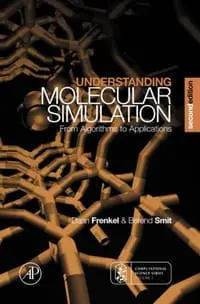
Understanding Molecular Simulation
出版时间
2001-10-19
ISBN
9780122673511
文件格式
评分
★★★★★
内容简介
Understanding Molecular Simulation: From Algorithms to Applications explains the physics behind the "recipes" of molecular simulation for materials science. Computer simulators are continuously confronted with questions concerning the choice of a particular technique for a given application. A wide variety of tools exist, so the choice of technique requires a good understanding of the basic principles. More importantly, such understanding may greatly improve the efficiency of a simulation program. The implementation of simulation methods is illustrated in pseudocodes and their practical use in the case studies used in the text.
Since the first edition only five years ago, the simulation world has changed significantly -- current techniques have matured and new ones have appeared. This new edition deals with these new developments; in particular, there are sections on:
· Transition path sampling and diffusive barrier crossing to simulaterare events
· Dissipative particle dynamic as a course-grained simulation technique
· Novel schemes to compute the long-ranged forces
· Hamiltonian and non-Hamiltonian dynamics in the context constant-temperature and constant-pressure molecular dynamics simulations
· Multiple-time step algorithms as an alternative for constraints
· Defects in solids
· The pruned-enriched Rosenbluth sampling, recoil-growth, and concerted rotations for complex molecules
· Parallel tempering for glassy Hamiltonians
Examples are included that highlight current applications and the codes of case studies are available on the World Wide Web. Several new examples have been added since the first edition to illustrate recent applications. Questions are included in this new edition. No prior knowledge of computer simulation is assumed.
AI 导读
编辑书评
- 本书的真正价值在于其“去神秘化”的努力。在分子模拟日益普及的今天,许多研究者沦为软件的被动使用者,却不懂为何选择某种系综或截断半径。Frenkel和Smit通过严谨的物理推导,揭示了算法背后的统计力学本质,使读者能从第一性原理出发评估模拟结果的可靠性。相较于市面上大量针对特定软件(如GROMACS或LAMMPS)的操作手册,本书具有更持久的生命力,因为它传授的是不变的物理规律,而非易变的软件接口。尽管其对量子效应或极复杂多尺度耦合的覆盖有限,但在经典分子模拟领域,它依然是无可替代的思维训练器。值得所有严肃的模拟研究者反复研读,尤其是在遇到模拟瓶颈时,回归本书往往能找到破局的关键线索。
- 作为编辑,我认为本书的局限在于其对最新机器学习势函数或增强采样技术的覆盖相对滞后,毕竟第二版出版距今已有多年。然而,这并不削弱其作为基础理论框架的核心地位。与同类书籍相比,它的独特之处在于平衡了数学严格性与物理直观性,避免了过度形式化的陷阱。对于急需上手特定项目的工程师,本书可能显得“太慢”;但对于致力于开发新方法或深入理解材料微观机制的科学家,这是必读之作。建议在阅读时搭配最新的综述文献,以弥补其在前沿算法上的时效性缺口。总体而言,这是一本值得放在案头随时查阅的工具型经典,其教育意义远超单纯的知识点罗列。
核心看点
- 本书核心在于揭示分子模拟背后的物理原理,而非单纯提供算法代码。作者明确指出这不是“食谱书”,而是解释为何选择特定技术解决特定问题的理论基石。通过阐述蒙特卡洛与分子动力学的基本假设、系综理论及采样方法,帮助读者理解从统计力学到计算实现的逻辑链条,从而提升模拟效率并避免盲目套用公式导致的错误结果。
- 内容涵盖从基础算法到高级应用的完整体系,包括长程相互作用处理、吉布斯系综法研究相平衡等关键难点。书中不仅讲解经典力场下的模拟,还涉及自由能计算和相变机制的理论分析。这种从微观粒子运动到宏观热力学性质推导的连贯性,使得读者能够掌握如何处理复杂体系中的边界条件与收敛问题,为实际科研中的模型构建提供严谨的方法论指导。
- 强调理论与实践的结合,通过伪代码展示算法实现细节,并辅以案例研究说明实际应用。尽管不依赖具体编程语言,但其对算法流程的清晰拆解(如重要性采样、随机行走)让读者能深入理解计算机模拟如何近似真实实验过程。这种设计旨在培养读者的批判性思维,使其在面对新出现的模拟工具时,能基于底层物理逻辑判断其适用性与局限性。
读者共识
- 读者普遍认可本书作为“分子模拟圣经”的地位,认为其简洁明快地阐述了复杂理论。许多评论指出,相比其他冗长的教材,本书直击核心,尤其是对Discussion部分的优雅写作给予高度评价。它成功地将晦涩的统计物理转化为可操作的模拟思路,被广泛视为该领域最权威且易读的入门经典之一。
- 部分资深用户提到,虽然本书质量极高,但1980年代剑桥出版的液体动力学模拟著作仍有借鉴价值。然而,鉴于本书获取方便、价格合理且内容更新及时,大多数读者仍将其作为首选。共识在于:它是连接理论与应用的桥梁,特别适合需要快速建立正确物理图像的研究者,而非仅仅寻找代码片段的人。
- 读者一致认为本书适合有一定数理基础的入门者,强调“非食谱书”的定位至关重要。大家赞赏其不局限于特定软件,而是教授通用的物理思维。对于做分子模拟的新手,本书提供了必要的统力基础指引;而对于有经验者,则有助于反思现有方法的理论依据。整体评价为高评分、高实用性的经典参考书。
精彩摘录
- "This book is not a computer simulation cookbook . our aim is to explain the physics that is behind the " recipes " of molecular simulation of course , we also give the recipes themselves , because otherwise the book would be too abstract to be of much practical use . the scope of this book is necess"
读者评论
其实1980s剑桥的那本液体动力学模拟依然值得借鉴,但是这本书比较方便的到而且价格合理,推荐这个网站:http://www.pages.drexel.edu/~cfa22/msim/ 基本的重点网页都有讲解,非常画龙点睛。最棒的是提供C代码可以动手实践,比干讲理论好太多了。
正如作者所言,此书讲的是分子模拟背后的理论,not a cookbook, it is physics that behind the recipes of molar simulation, nice one. 写作学习亦可用,尤其Discussion section is elegant.
做分子模拟很好的入门 需要统力基础
简洁明快
Academic Press的其他书籍查看全部
 《Biological Distance Analysis》
 《Machine Learning》
 《Doing Bayesian Data Analysis (2/e)》
 《The Laboratory Rabbit, Guinea Pig, Hamster, and Other Rodents》
 《Network Coding》
 《Mathematical Modeling, Third Edition》